Ten Nights Dreaming by Natsume Soseki
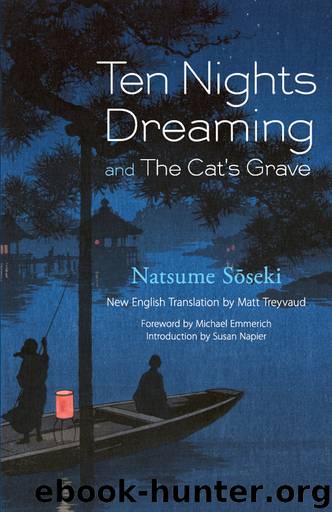
Author:Natsume Soseki [Soseki, Natsume]
Language: eng
Format: epub, azw3
Publisher: Dover Publications
Published: 2015-02-15T05:00:00+00:00
* * *
1. Age of the Gods: The traditional name for the era in Japanese mythology before the accession of the first emperor, Jimmu.
2. Amanojaku: A malicious figure in Japanese folklore who works to thwart and subvert human desires.
The Sixth Night
The Sixth Night
Unkei was an influential Japanese Buddhist sculptor who died in 1223, but the modern narrator of the sixth dream nevertheless finds him at work at Gokoku-ji, a temple in Tokyo that was not established until 1681.
Hearing that the sculptor Unkei was carving the Two
Benevolent Kings1 at the main gate of Gokoku-ji, I decided to stroll over and take a look. I arrived to find a large crowd already gathered and vigorously exchanging opinions on the word in progress.
A large red pine stood about seven or eight yards in front of the gate, trunk stretching towards the distant blue sky at just the right angle to obscure the gate’s tiled roof. The pine’s green foliage and the red lacquered gate contrasted beautifully with each other. The pine was well positioned, too. Rising unobtrusively from the left of the gate, growing broader as it slanted up and across to reach the roof, it had an antiquated air, even putting me in mind of the Kamakura era.2
But the people watching were all of the Meiji era,3 just as I was. In fact, the larger part of the crowd was rickshaw drivers. No doubt they had grown bored of simply standing around waiting for passengers.
“Talk about big!”
“Must be a lot more work than carving a person.”
As I considered this, another man spoke. “Huh, it’s the Benevolent Kings. They’re still carving the Benevolent Kings? You don’t say! I thought that all the Benevolent Kings were old as the hills.”
“They do look strong, eh?” a different man said to me. “You know what they say, right? — there’s never been anyone stronger than the Two Benevolent Kings. They say they were even stronger than Yamato-Dake no Mikoto!”4 This man had his kimono tucked up around his waist, and wore no hat. He looked decidedly uneducated.
Unkei kept his hammer and chisel in motion, utterly ignoring the commentary from his audience. He did not even glance behind him. Perched high above, he stayed hard at work carving out the faces of the Benevolent Kings.
Balanced on Unkei’s head was something like a small eboshi5. I couldn’t tell what his clothes were made of — perhaps rough, unlined suō6 — but his loose sleeves were tied back to keep them out of the way. The effect was quite archaic. It made for a jarring contrast with his chattering audience. Why, I wondered, was Unkei still alive in the present day? It was a mystery to me, but I did not stop watching.
Unkei, for his part, remained focused solely on his carving, apparently not finding the situation mysterious or odd in the slightest.
A young man who had been gazing up at all this turned to me. “That’s Unkei for you!” he said, enrapt. “We’re not even here for him. It’s as if he’s saying, ‘The only heroes under heaven are the Benevolent Kings and I.
Download
This site does not store any files on its server. We only index and link to content provided by other sites. Please contact the content providers to delete copyright contents if any and email us, we'll remove relevant links or contents immediately.
In Control (The City Series) by Crystal Serowka(36203)
The Wolf Sea (The Oathsworn Series, Book 2) by Low Robert(35222)
We Ride Upon Sticks by Quan Barry(34503)
Crowbone (The Oathsworn Series, Book 5) by Low Robert(33596)
The Book of Dreams (Saxon Series) by Severin Tim(33357)
The Daughters of Foxcote Manor by Eve Chase(23599)
Trainspotting by Irvine Welsh(21624)
Call Me by Your Name by André Aciman(20478)
The Secret History by Donna Tartt(19011)
Shot Through The Heart (Supernature Book 1) by Edwin James(18906)
All the Missing Girls by Megan Miranda(15910)
American King (New Camelot #3) by Sierra Simone(15773)
The Girl from the Opera House by Nancy Carson(15766)
Pimp by Iceberg Slim(14472)
Sad Girls by Lang Leav(14396)
The Betrayed by Graham Heather(12805)
The Betrayed by David Hosp(12762)
4 3 2 1: A Novel by Paul Auster(12360)
Still Me by Jojo Moyes(11244)
